
A company can spend months getting its message right. The positioning, the product descriptions, the promises made to customers. Then that message goes into another language, and the people responsible for approving it may no longer be able to judge whether it says what they intended.
As AI makes multilingual content faster to produce, that question becomes more urgent: who checks what reaches the customer?
Deloitte’s January 2026 State of AI in the Enterprise report found that just 21% of surveyed organizations reported having a mature governance model for autonomous AI agents.
That is a finding about agentic AI governance, rather than translation quality specifically. It does not mean the remaining 79% have no controls. But it raises a question that matters for multilingual businesses: Is content production moving faster than oversight?
Read Deloitte’s State of AI in the Enterprise report.
Multilingual content needs its own quality checks
An approved English page does not automatically mean its translated versions are ready to publish.
A translation can read smoothly while changing a detail, weakening a promise or using a term that means something different in context. For a reader who cannot compare both languages, those problems can be difficult to spot.
Consider a hotel description, a product specification or a customer support instruction. Each has a job to do. The translation must preserve the information that lets the customer make the right decision.
As more content moves through automated workflows, checking that meaning survives the journey needs to become a routine step.
A small spot check of a global luxury hotel chain’s website
I recently used LanguageCheck.ai to check a small sample from a page on a global luxury hotel chain’s website.
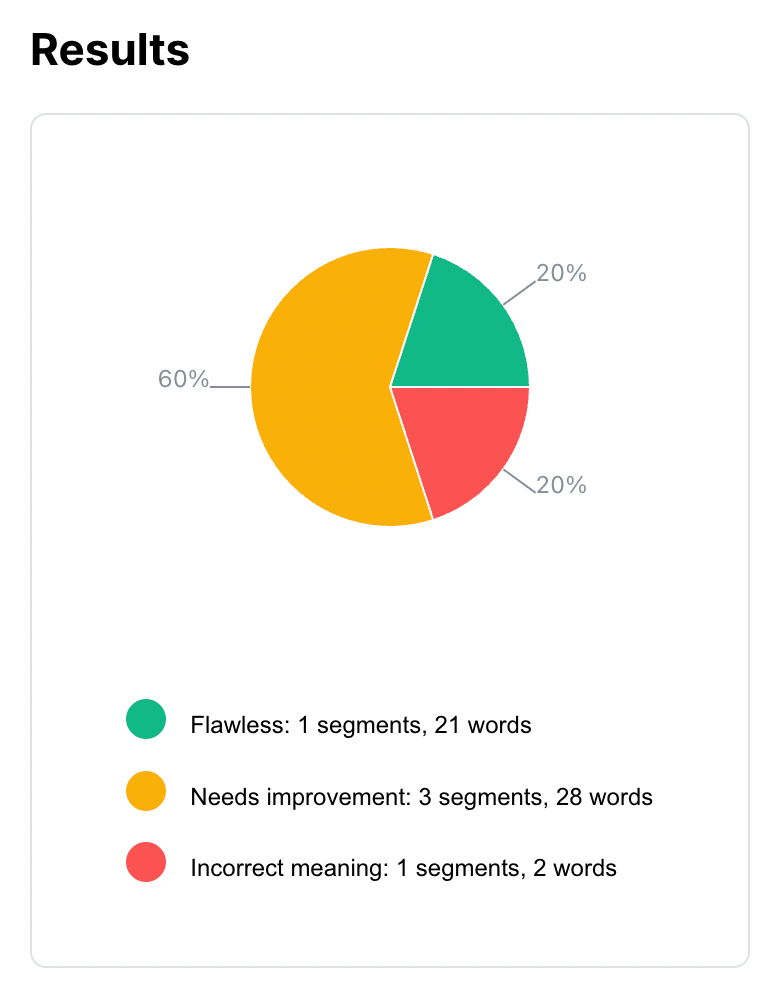
The report covered five segments:
| LanguageCheck.ai classification | Segments |
| Flawless | 1 |
| Needs Improvement | 3 |
| Incorrect Meaning | 1 |
One segment was flagged for incorrect meaning, while three were marked as needing improvement. Those are different findings: a suggested improvement is not automatically a mistranslation.
This was a limited spot check, not an audit of a global luxury hotel chain’s website. We do not know whether the translations were produced by people, machine translation, generative AI, or a combination. The summary shows the tool’s classifications; the flagged source and target text still need to be examined in context.
What makes the example useful is the practical question it poses. If a check of five segments identifies something worth investigating, how does a team find similar issues across hundreds of pages and multiple languages?
Where LanguageCheck.ai fits
LanguageCheck.ai provides a dedicated translation quality assurance step: comparing source and translated content and flagging segments that may need attention.
That gives reviewers a focused starting point. They can investigate potential meaning errors and assess suggested improvements, using their knowledge of the audience, terminology, and context to decide what should change.
The principle is simple: review only what matters.
For a company publishing in several languages, this creates a practical way to introduce more consistent checks. For a language service provider, it supports the review work that sits between producing a translation and delivering it to a client.
The value applies whether the original translation came from an AI tool, a machine translation engine, or a human translator.
LanguageCheck.ai supports the linguistic accuracy part of that process. It does not independently establish whether the source’s claims are true, certify legal compliance, or guarantee that every error will be detected. Those responsibilities still need the right people and controls.
Build quality assurance into the publishing process
Our view is that multilingual quality assurance should become a standard part of how businesses scale content.
A practical workflow starts with an approved source, checks the translation against it, routes flagged issues to a qualified reviewer, and gives someone responsibility for the final release. Updated content needs renewed checks.
LanguageCheck.ai is built to support that future by helping teams identify where their multilingual content needs closer attention.
The more efficiently a business can produce translations, the more valuable it becomes to know which parts need review before customers see them.
See what a quality check reveals in your own content.
Submit a bilingual file for a LanguageCheck.ai QA demo.